

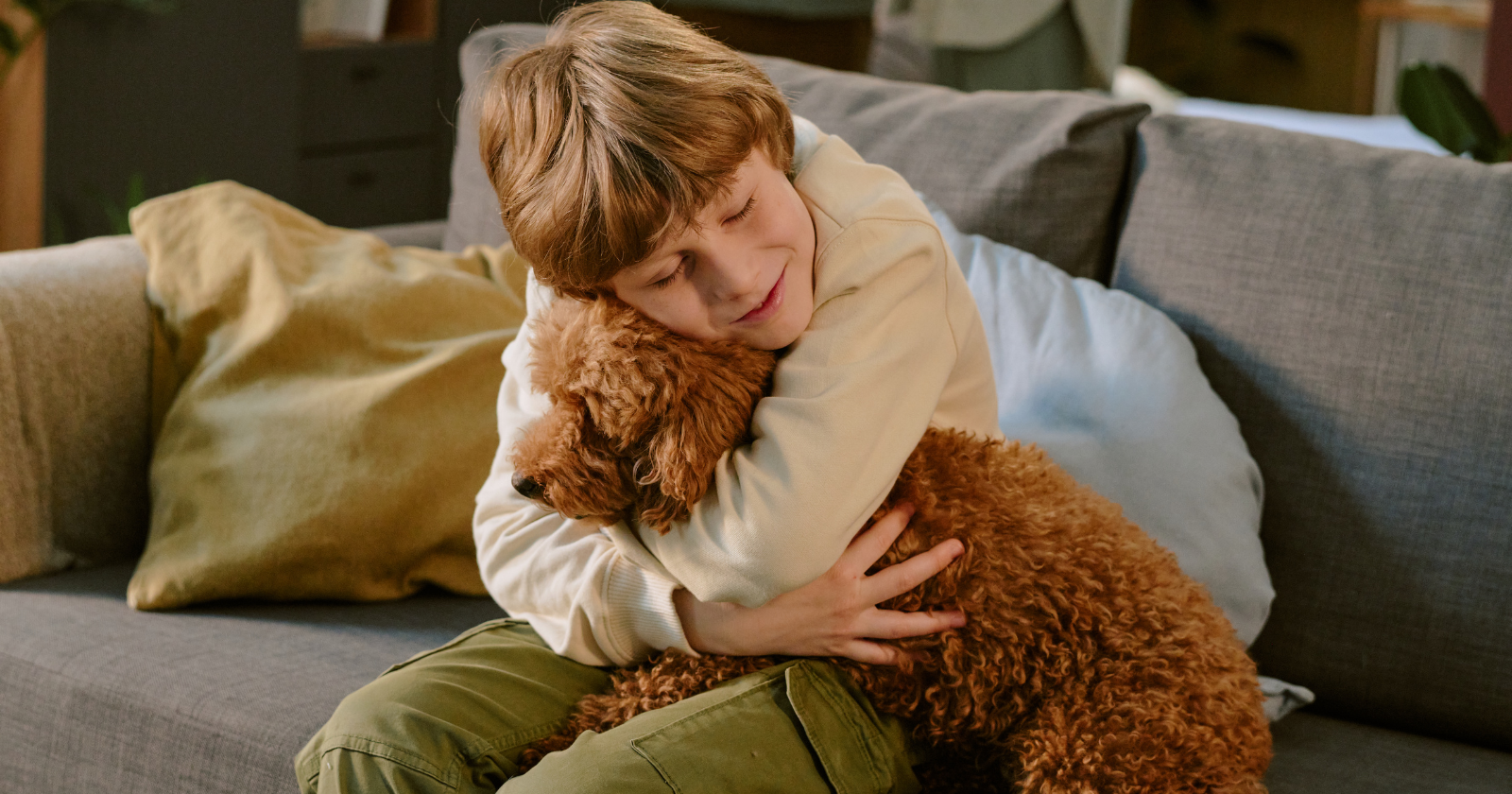
Research suggests the reason people who grew up without affection often form their deepest bonds with animals isn’t preference, it’s safety — because an animal provides consistent, non-verbal, physically warm connection with no possibility of rejection, withdrawal, or the conditional love that made human closeness feel like a trap, and the adult who sleeps with a dog pressed against their chest is often replaying an attachment that was never safely available from a person


I watched my neighbor yesterday, a woman in her fifties who lives alone, greeting her golden retriever after work.
The way she melted into that dog, burying her face in his fur while he wiggled with pure joy, told a story I recognized in my bones.
Growing up in a house where my mother’s moods shifted like weather and my father existed somewhere just beyond reach taught me that human love came with conditions, tests, and the constant threat of withdrawal.
But a warm body pressed against you in the dark asks for nothing except your presence.
When touch becomes dangerous
Think about what happens to a child who learns that reaching for comfort might result in rejection.
Or worse, that showing need invites criticism.
Wikipedia Contributors note that “Harry Harlow was an American psychologist best known for his maternal-separation, dependency needs, and social isolation experiments on rhesus monkeys, which manifested the importance of caregiving and companionship to social and cognitive development.”
Those experiments showed something devastating yet illuminating.
The baby monkeys would choose a soft, warm surrogate mother over one that provided food.
They needed the comfort of touch more than sustenance itself.
Now imagine a child whose primary caregivers couldn’t provide that soft landing.
The nervous system learns early that connection equals unpredictability.
I spent nights as a child lying awake, replaying arguments in my head, trying to decode the patterns that might prevent the next explosion.
My body learned to stay vigilant around the very people who were supposed to make me feel safe.
The language that needs no words
Animals speak in consistency.
A cat’s purr doesn’t change based on your performance that day.
A dog’s tail wag doesn’t depend on whether you said the right thing at dinner.
This predictability creates something profound for those of us who grew up translating every micro-expression, every shift in tone, every silence.
• They offer physical warmth without emotional cost
• Their affection doesn’t fluctuate with their mood
• They never weaponize vulnerability
• Their presence remains steady even when you’re falling apart
The research backs this up too.
JAMA Network Open found that “Higher attachment to pets, especially dogs, was significantly associated with lower anxiety and depression symptoms.”
This isn’t just about preferring animals to people.
This is about finding the first safe harbor many of us ever knew.
Rewriting the attachment story
I remember sitting on my couch during my first marriage, my ex-husband just feet away, feeling lonelier than I’d ever felt living alone.
Human proximity without emotional safety creates a particular kind of isolation.
But my cat would curl into the hollow of my neck, her heartbeat against my throat, and suddenly I wasn’t alone anymore.
She didn’t need me to be different, better, or less complicated.
The animal doesn’t mirror back our childhood wounds the way human relationships often do.
They don’t trigger the same defensive patterns.
When you’ve learned that love means walking on eggshells, the straightforward affection of an animal feels revolutionary.
They teach us what unconditional actually means.
Not through words or promises that can be broken.
Through the simple act of showing up, day after day, with the same open heart.
The bridge back to human connection
Here’s what I’ve learned through years of meditation and therapy.
The safety we find with animals can become a template for what we seek in human relationships.
Not everyone who loves animals had a difficult childhood, of course.
But for those of us who did, that bond often represents our first experience of secure attachment.
The dog who sleeps pressed against your chest isn’t just keeping you warm.
They’re teaching your nervous system what safety feels like.
They’re showing you that love doesn’t have to hurt.
Some people judge adults who seem closer to their pets than to other humans.
They don’t understand that for many of us, that animal relationship was the classroom where we learned trust was possible.
Where we discovered that we were worthy of unconditional love, even if we’d never received it from a person.
The path forward isn’t choosing animals over humans.
The path involves recognizing why we needed that safe connection and using it as a foundation to slowly, carefully, build bridges back to human intimacy.
With boundaries this time.
With the knowledge that we deserve consistency and warmth.
Next steps
If you recognize yourself in this, know that your bond with animals isn’t weakness or avoidance.
You found safety where you could.
You met your attachment needs with the resources available.
That’s not just survival.
That’s wisdom.
The question now becomes: How can the safety you’ve found with animals teach you what to look for in human connections?
What would it mean to expect the same consistency, the same unconditional presence, from the people you allow close?
Your animal taught you what love without conditions feels like.
Now you get to decide whether you’ll accept anything less from the humans in your life.