

Psychology says people who’ve genuinely found inner peace don’t talk about it constantly — they display quiet behaviors that signal a level of emotional freedom most people never reach



Inner peace is one of those phrases that has been so thoroughly co-opted by wellness branding and social media aesthetics that we’ve lost sight of what it actually looks like in a living, breathing person. We imagine someone cross-legged on a cliff at sunrise, captioning their photo with something about gratitude. But the people I’ve encountered who genuinely carry a settled quality inside themselves are almost never the ones talking about it. They’re the ones who make you feel calmer just by sitting next to them, and you can’t quite explain why.
I’ve been chasing some version of inner peace since I was about twenty-nine, when anxiety finally drove me to a meditation cushion in a community center basement on the Upper West Side. And what I’ve noticed over nearly a decade of practice, therapy, and paying close attention is that the real thing, when it shows up, is almost invisible. It doesn’t announce itself. It lives in the margins of behavior, in what someone doesn’t do as much as what they do.
The loudness problem
There’s a specific kind of person who talks about inner peace the way someone might talk about a luxury vacation. They’ve arrived, and they want you to know. They quote Rumi on Instagram. They tell you they’ve “let go” of things while clearly still gripping them with both hands. They describe their morning rituals with a level of detail that starts to feel like performance.
I know this person well, because I’ve been this person.
About four years ago, fresh out of my divorce and deep into my meditation practice, I went through a phase where I couldn’t stop narrating my own growth. I told friends about my breathwork sessions. I described my journaling breakthroughs at dinner parties. I thought I was sharing. What I was actually doing was seeking confirmation that I was okay. That all the inner work was working. The need to talk about peace was, itself, evidence that I hadn’t fully found it yet.
As practitioners working in therapeutic settings focused on inner peace often emphasize, research on inner peace suggests that it frequently has to be created through sustained internal work rather than simply discovered. And that process is quieter than we’ve been led to believe.
What the quiet behaviors actually look like
When I started paying attention to the people around me who seemed genuinely unburdened (not performing unburdened, but actually settled in their own skin), I noticed a set of behaviors that kept repeating. None of them are dramatic. Most of them would go completely unnoticed if you weren’t looking.
They don’t correct people who misunderstand them
This was the first one I noticed, and it still startles me when I see it. My husband does this. Someone will mischaracterize something he said or attribute a motivation to him that isn’t accurate, and he’ll just let it sit there. No defensiveness. No urgent need to set the record straight. The first few times I witnessed it, I thought he was being passive. Now I understand he simply doesn’t need external validation of his own experience. He knows what he meant. That’s enough.
Compare this to how I used to operate: I’d spend twenty minutes after a misunderstanding crafting the perfect clarifying text. I couldn’t tolerate being seen inaccurately. That desperation to be understood is the opposite of peace. It’s a form of surveillance over other people’s perceptions of you.
They let conversations end naturally, even in silence
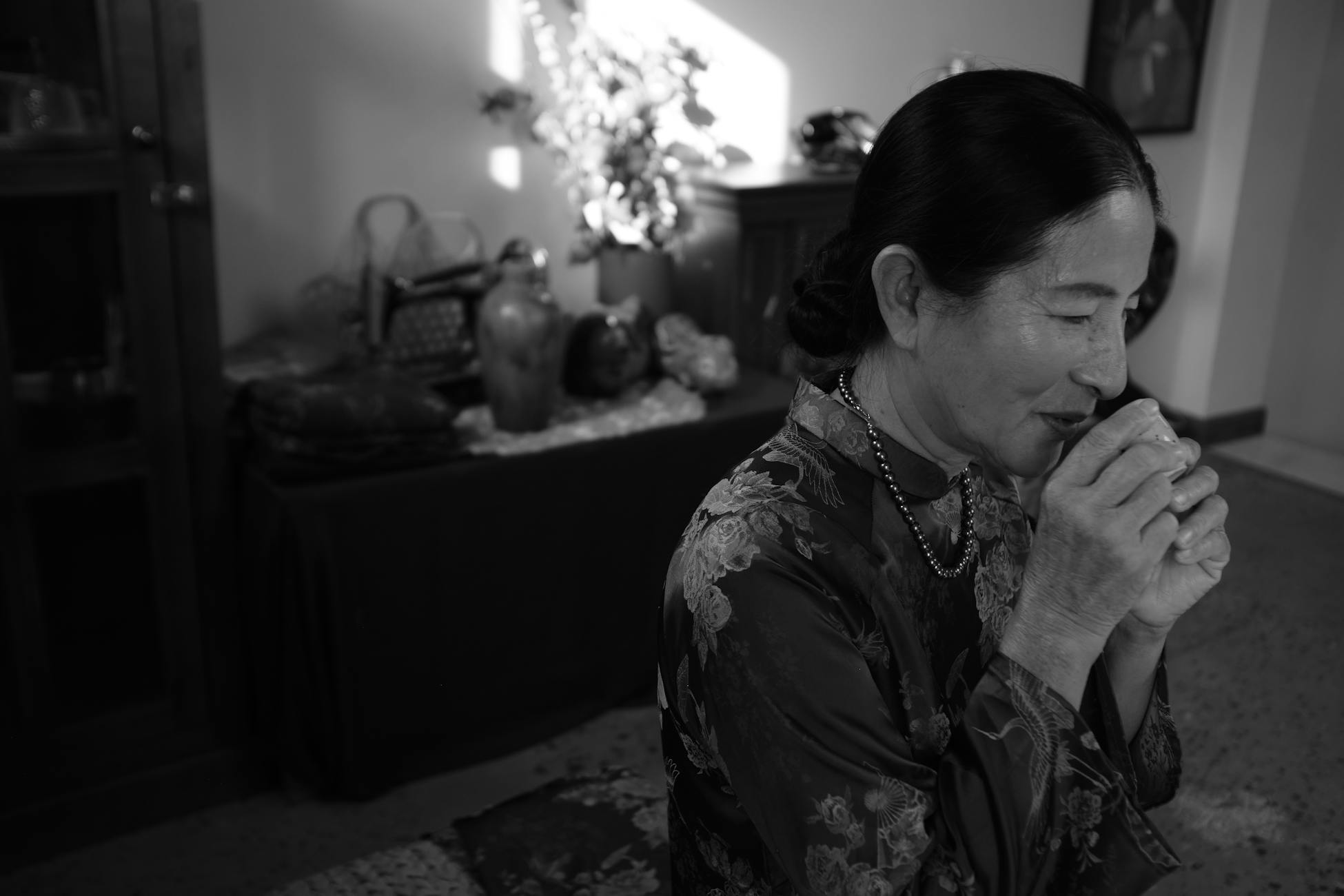
At my weekly meditation circle, there’s a woman named Claire who has this quality I find almost magnetic. When a conversation reaches its natural conclusion, she doesn’t rush to fill the gap. She’ll smile slightly, take a sip of tea, look out the window. There’s no panic in the pause. No scrambling for the next topic. She treats silence the way most people treat noise: as a perfectly acceptable backdrop for being alive.
I’ve written before about how people become quieter in relationships for all sorts of reasons, and not all of them are healthy. But when someone can sit in silence without anxiety, without the compulsion to perform engagement, that’s a different kind of quiet. That’s peace leaking through the cracks of ordinary life.
They celebrate other people without comparison
This one is subtle but telling. Emotionally free people hear about someone else’s success, joy, or breakthrough and respond with something that feels clean. No undertone of comparison. No “that’s great, I’ve been meaning to do something like that too.” No immediate pivot back to their own experience. They can hold someone else’s good news without it activating their own sense of lack.
I catch myself failing at this more than I’d like to admit. A friend mentions a book deal or a retreat she’s attending, and before I can stop it, my brain runs a quick inventory of my own accomplishments. It happens fast, almost below consciousness. People who’ve reached genuine emotional freedom seem to have quieted that reflex entirely.
They don’t keep score in relationships
This goes beyond generosity. Scorekeeping is a form of self-protection, a ledger we maintain to ensure we’re not being taken advantage of. People with inner peace tend to give without tracking. They host without noting who hosted last. They listen without calculating whether they’ve been listened to in return.
This doesn’t mean they lack boundaries. In fact, every genuinely peaceful person I know has remarkably clear boundaries. The difference is that their boundaries come from self-knowledge rather than resentment. They say no when they mean no. They don’t over-give and then silently stew about it. The absence of scorekeeping isn’t naivety. It’s the result of knowing exactly what you’re willing to offer and being honest about it upfront.
They respond to criticism with curiosity rather than defense
Last month, someone in my book club pushed back on a point I’d made about a novel we were reading. My first instinct was to defend my interpretation, sharpen my argument, win. But I watched myself have that instinct, and then I watched it pass. I got curious about what she was seeing that I’d missed. It was a small moment, but it felt like progress.
People who live in this state consistently (not just in occasional flashes) have developed what I think of as a kind of porousness. Criticism passes through them rather than sticking. They can absorb feedback without it threatening their sense of self. This kind of tolerance for not knowing, for being wrong, is one of the rarest emotional skills I’ve encountered.

The behaviors that signal something deeper
Beyond these individual habits, there’s a broader pattern that connects them. People who’ve arrived at genuine inner peace tend to have a specific relationship with time. They move through their days without the frantic quality that characterizes so much of modern life. They aren’t rushing toward some future version of themselves that will finally be enough. They aren’t replaying past conversations to extract different outcomes.
As research on understanding and cultivating inner peace points out, the search for tranquility often leads people to look in all the wrong places. External achievements, relationships, possessions. The people I’ve observed who actually have it seem to have stopped searching altogether. They’ve settled into an acceptance of present reality that doesn’t require constant improvement projects.
This doesn’t mean they’re stagnant. My husband reads voraciously, takes on new projects, stays engaged with the world. But there’s an absence of desperation in his growth. He pursues things because they interest him, not because he’s trying to outrun a feeling of inadequacy. The motivation is curiosity, not fear.
Why most of us find this so difficult
I grew up in a house where peace was the absence of conflict, which meant peace was always temporary. Always conditional. My mother’s mood could shift the entire atmosphere of our home in seconds. I learned early that calm was something that could be taken from you, so you’d better enjoy it while it lasted but never trust it.
That conditioning runs deep. When I first started meditating, I couldn’t sit still for five minutes without my body flooding with anxiety. Stillness felt dangerous because in my childhood, stillness was just the pause before the next storm. I think many of us carry some version of this: the belief that peace is fragile, that it can only exist in the spaces between crises.
The people who’ve genuinely found it seem to have worked through that belief at a fundamental level. They’ve arrived at a place where peace isn’t a temporary state but a baseline. And that work, that deep rewiring, is precisely why they don’t feel the need to talk about it constantly. When something becomes your default, you stop narrating it. You don’t announce every breath you take.
There’s an interesting parallel here with how people who carry certainty into later life can become rigid and closed. Inner peace, paradoxically, requires the opposite of certainty. It requires a willingness to not know, to not control, to let things be unresolved. The peaceful people I know are comfortable with ambiguity in a way that most of us find profoundly uncomfortable.
What I’m still learning
I’m not going to pretend I’ve arrived at this place myself. Some mornings I wake up at 5:30 for meditation and spend the entire thirty minutes mentally rehearsing a difficult conversation. Some weeks I catch myself narrating my growth again, packaging my insights for other people’s consumption, using the language of peace as a shield against the messiness I still feel.
But I notice it now. That’s the shift. I notice the gap between talking about peace and embodying it. And in the noticing, something loosens. I can feel myself moving, slowly and imperfectly, toward the kind of quiet that doesn’t need an audience.
The people who’ve made it further down this path than I have share a quality I keep coming back to: they’ve stopped trying to prove anything to anyone, including themselves. Their performance of self has quieted. What’s left is something unpolished and real, and it radiates outward in ways no Instagram caption ever could.
The truest peace I’ve ever witnessed didn’t come with a soundtrack or a lesson. It was my husband, last Tuesday, sitting on our couch reading a book while rain hit the windows, not looking up, not needing anything, not performing contentment for my benefit. Just existing. Fully in the room. Fully at rest. And the quiet of it filled everything.