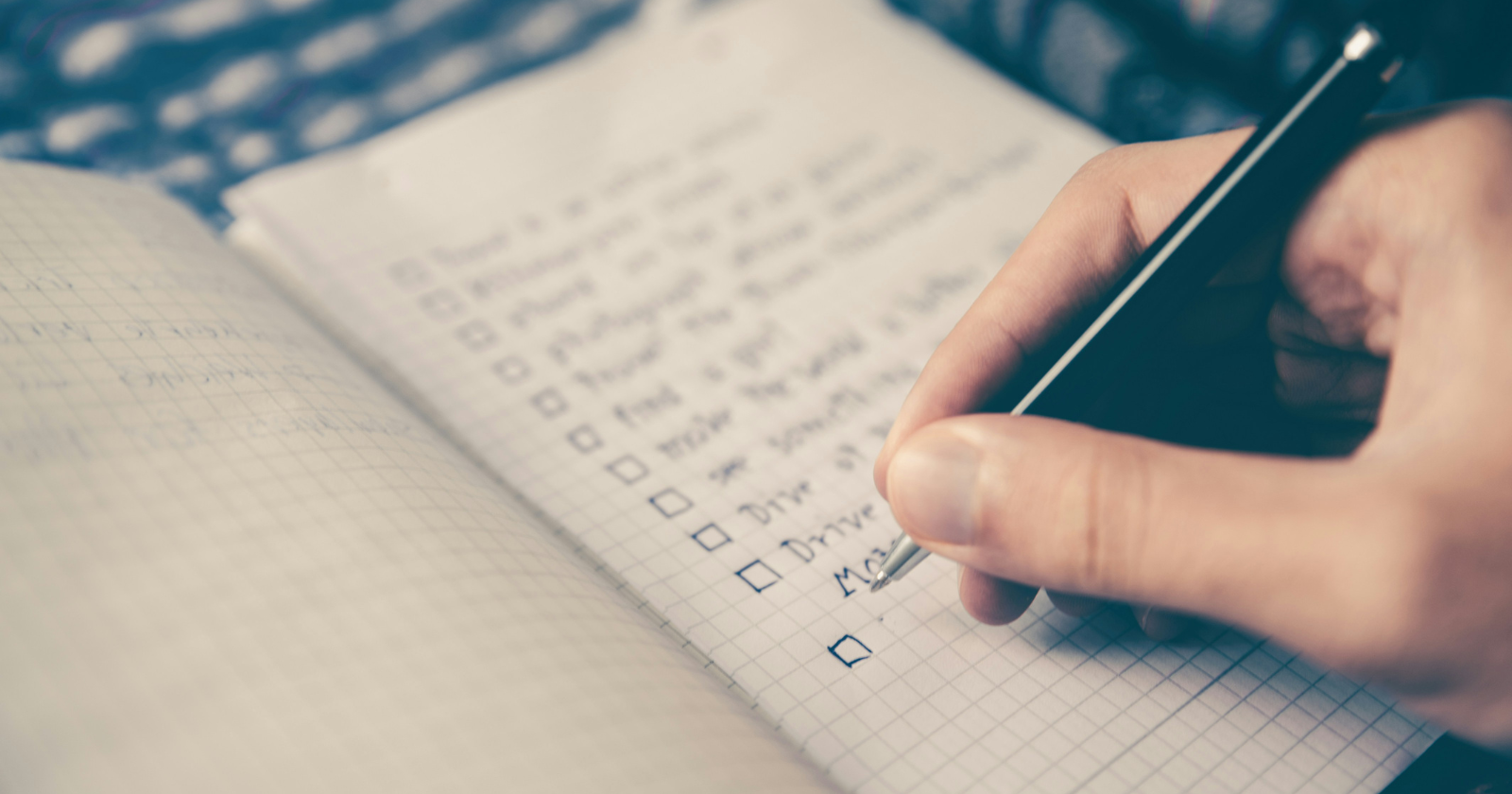
Two people sit down to make the same grocery list. One reaches for a pen, the other opens a notes app on their phone. Ten minutes later, the typed list runs to thirty-one items, including three kinds of mustard and a note to check whether the parchment paper is still in the drawer. The handwritten list has nine items, and every single one of them is something the kitchen is actually out of.
The easy read on that difference is personality: the handwriter is disciplined, the typist is scattered. But hand the disciplined one a keyboard for the same task, and the list balloons the same way it always does once a keyboard is involved. What decides the outcome is speed, specifically how fast each tool lets a hand move across the page or the keys.
Why the slower tool ends up choosing for you
A pen moves at a fraction of typing speed, so someone taking handwritten notes is racing their own thoughts the entire time. That pressure pushes the decision-making earlier. Instead of getting everything down and sorting it out later, the hand has to decide, sentence by sentence, which words are worth keeping before the next one arrives. Typing removes that pressure almost entirely, since a fast typist can often keep pace with speech.
A 2014 study by psychologists Pam Mueller and Daniel Oppenheimer, then at Princeton and UCLA, tested this directly. College students took notes on the same recorded lecture, some by hand and some on a laptop, and were tested afterward on what they remembered. Laptop notes came out longer and closer to a full transcript. The researchers pointed to a simple mechanical reason for it: “Laptop use facilitates verbatim transcription of lecture content because most students can type significantly faster than they can write.”
Handwriting speed puts a hard ceiling on how much a person can copy down word for word. That ceiling is what turns summarizing and selecting the main point into something closer to automatic, built into the physical act of writing by hand rather than into the writer’s willpower. It’s a side effect of the medium itself, showing up whether or not the person holding the pen thinks of themselves as an editor.
The result didn’t hold up the second time it was tested
Mueller and Oppenheimer’s finding spread quickly beyond academic journals, showing up in TED talks, productivity blogs, and school newsletters urging parents to get their kids writing by hand instead of typing. Five years later, a team at Kent State set out to check whether it held up under a bigger, more careful look.
“Some trends suggested longhand superiority; however, performance did not consistently differ between any groups.” That is what the team, led by Kayla Morehead alongside John Dunlosky and Katherine Rawson, reported after running several new experiments, larger than the original study and designed specifically to reproduce it.
That matters. The original study is still one of the most cited pieces of note-taking research around, and the mechanism behind it, that slower writing forces selection, is sound reasoning on its own terms. Sound reasoning and a reliably repeatable test score turned out to be two different things, though, and on actual test performance, the larger follow-up came back far less certain than the first study did. Whatever handwriting is doing while someone composes a sentence, it isn’t guaranteed to translate into a higher score on a quiz afterward.
What a wired-up brain adds to the picture
A separate line of research skips test scores altogether and looks at the brain directly while someone is writing. Neuropsychologist Audrey van der Meer and her co-author, at the Norwegian University of Science and Technology, fitted more than thirty participants with a high-density EEG cap and had them either write words by hand with a digital pen or type them using one finger on a keyboard. Handwriting produced noticeably broader connectivity across brain regions than typing did, in frequency bands that existing research links to forming memories and taking in new information.
That’s worth taking seriously, and also worth not overreading. The study never tested whether people remembered anything better afterward, since nobody sitting in the EEG cap was actually learning course material. That gap is exactly what a formal response to the paper focused on. Cognitive scientists Svetlana Pinet and Marieke Longcamp, publishing a commentary in the same journal, weren’t convinced the classroom conclusion follows: as they put it, “the protocol did not include any learning,” since participants, in their words, “repeatedly wrote well-known words without any requirement for memory encoding.”
In plainer terms, a brain pattern connected to memory formation is not automatically evidence that handwriting helped anyone actually remember more that day. The honest version of this finding is that the brain is doing something different under each condition, and whether that different pattern helps anyone learn or recall more is still an open question researchers are working through.
What actually changes when you pick up a pen
These three findings, taken together, don’t settle anything about intelligence, memory, or how smart a person is for choosing one tool over the other, and that was never really the useful question. What holds up, even with the replication trouble and the EEG caveats attached, is the plain mechanical fact sitting underneath all of it: a pen is slower than a keyboard, and that speed limit is what forces a decision partway through the sentence.
Write “milk,” “eggs,” and “the good bread, the one that isn’t pre-sliced” fast enough by hand, and something has to get cut on the way to the paper, so cutting becomes part of the process rather than an afterthought. Type the same list, and no equivalent pressure tells anyone which four words matter more than the other twenty-seven; everything fits, so everything stays.
For a grocery run, that’s a small, low-stakes place to notice the difference. But it’s close to the same mechanism editors describe when they talk about a first draft: the version trimmed down while it’s still being written tends to hold up better than the version that gets everything down and gets sorted out later. A shorter list, in someone’s own shorthand, might be the clearest evidence available right now that choosing what to leave out is its own kind of skill, whether or not a lab has fully measured it yet.