Long before a writer could research a setting from a laptop, the only cities that made it into fiction were the ones an author had actually walked through, argued in, gotten lost in, or grown up inside. Some of the most enduring novels in the world weren’t set in an invented place at all. They were built out of a real city’s streets, weather, and class divisions, close enough to the original that readers can still retrace a character’s route today. Here are nine cities that didn’t just host a famous novel. They shaped it.
1. Dublin, Ireland
James Joyce’s Ulysses unfolds over a single day, June 16, 1904, tracing its characters through specific, real Dublin streets, pubs, and shorelines. As Britannica’s account of the novel lays out, that single day in and around the city is now celebrated every year as Bloomsday. Joyce reportedly chose the date because it marked his first outing with Nora Barnacle, the woman he would eventually marry, which means one of modern literature’s most famous cities is mapped onto what was, for Joyce personally, an ordinary walk that mattered.
2. Saint Petersburg, Russia
Fyodor Dostoevsky’s Crime and Punishment is inseparable from the city’s damp, crowded core. An Oxford University Press analysis of the novel locates its action around the Haymarket district, a part of the city where imperial grandeur gave way fast to poverty and vice. Raskolnikov’s cramped garret, the pawnbroker’s apartment, and the bridges he crosses mid-crisis are all drawn from streets that still exist, which is why literary walking tours of the novel are still possible more than 150 years later.
3. Paris, France
Victor Hugo’s Les Misérables is often assumed to depict the French Revolution of 1789. It actually dramatizes a much smaller, failed uprising four decades later. Hugo began writing the novel in 1845, and a historical account of the book’s origins notes that he built the events of the June Rebellion, which he witnessed as a young man, directly into the story, having been caught near the fighting himself while it unfolded in the Tuileries Gardens. The barricades on the page were, for Hugo, a scene he had personally watched go up.
4. London, England
Charles Dickens filled his novels with real London geography, often placing his characters in addresses that mirrored streets he knew from his own difficult childhood in the city. Victorian Web’s mapping of Dickens’s London traces, for instance, the real City Road address that became the model for Mr. Micawber’s residence in David Copperfield, one of dozens of real locations scholars have matched to his fiction. Dickens didn’t just set stories in London. He used the city’s actual debtors’ prisons, workhouses, and slums as material.
5. Oxford, Mississippi, United States
William Faulkner never lived in the fictional Yoknapatawpha County he wrote about again and again, because he built it directly out of the place he did live. Geographer Charles S. Aiken, of the University of Tennessee, has documented how closely the fictional county’s geography follows the real Lafayette County, Mississippi, down to the position of its county seat, which mirrors Oxford, where Faulkner spent most of his life. An entire fictional American South grew out of one small college town.
6. Aracataca, Colombia
Gabriel García Márquez’s Macondo, the setting of One Hundred Years of Solitude, draws directly on his birthplace of Aracataca, a small town in Colombia’s banana-growing region. García Márquez traced the novel’s imaginative source to a single building, saying of his grandparents’ house there: “Everything I write has its origins in that house.” The magical realism the novel is famous for grew out of ordinary childhood memory rather than pure invention.
7. Prague, Czech Republic
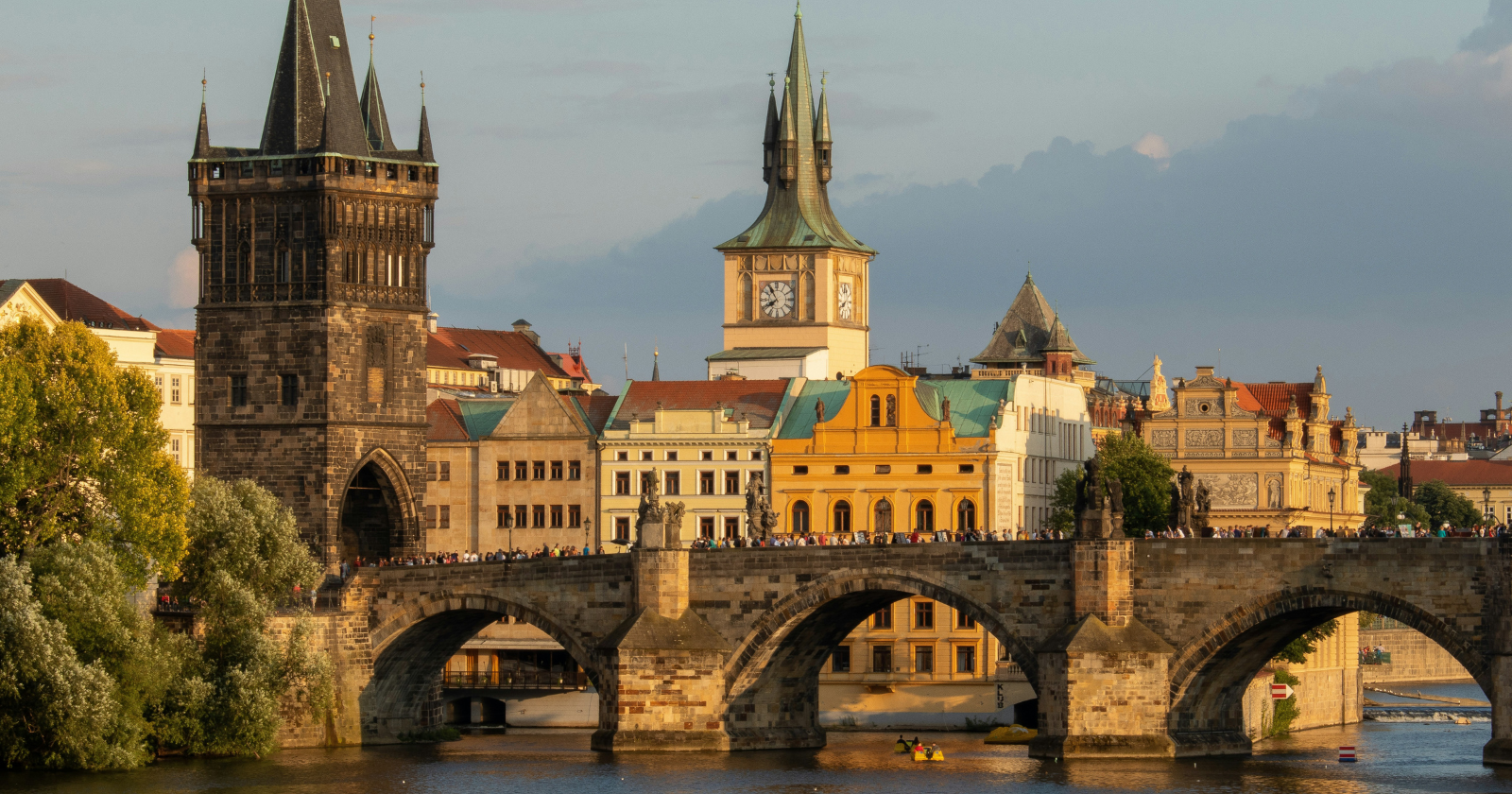
Franz Kafka rarely named real locations outright in The Trial, but Prague is embedded in the book’s geography all the same. According to the Franz Kafka Museum, “the anonymous cathedral in The Trial is none other than St. Vitus Cathedral,” and the path Josef K. walks in the novel’s final chapter traces an actual route across the Charles Bridge. Kafka disguised the city rather than erasing it, turning familiar landmarks into something closer to a maze.
8. Barcelona, Spain
Carlos Ruiz Zafón’s The Shadow of the Wind opens its central mystery in a very specific corner of Barcelona. Critic Xavier Aldana Reyes, writing in The Irish Times, describes the book’s setting as “the historical neighbourhood of El Raval, a maze of dark and narrow streets in postwar Barcelona.” The novel’s fictional Cemetery of Forgotten Books doesn’t exist, but the crumbling, atmospheric city around it does, and readers still show up looking for it.
9. Alexandria, Egypt
Lawrence Durrell’s four-volume Alexandria Quartet takes its name directly from its setting, and treats the city almost as a character in its own right. Britannica places the series in Alexandria, Egypt, during the 1940s, a period when the port city was a genuine crossroads of British, French, Greek, and Egyptian life. Durrell had lived and worked there himself, and the layered, contradictory versions of the same events across the four books mirror how differently a single city can look depending on who’s remembering it.
What connects all nine is less the fame of the novels than the specificity of the streets underneath them. A city gave each of these writers something an invented setting couldn’t: a real geography they could get wrong on purpose, a set of actual limitations to write against, and the strange advantage of having somewhere to point to and say, that’s where it happened. Some of these cities have leaned into the connection, building museums, walking tours, and festivals around a book set on their own streets. Others simply carry on as ordinary cities that happen to have supplied one writer with everything they needed, whether or not any tourist ever notices.
It’s worth remembering, too, that these were novelists, not travel writers. Every one of these cities got compressed, exaggerated, or rearranged to fit the story being told, which is exactly why the fiction outlasted the accurate version. A reader who visits Dublin expecting to retrace Ulysses street by street, or Barcelona expecting to find the Cemetery of Forgotten Books, is chasing something that was always part invention. That gap between the real city and the one on the page tends to be less a flaw in these novels than the reason they’re still read.